Chapter 3
Colonialism and imperialism have profoundly shaped the history of the United States and communities across the globe. In this lesson, we will explore the various ways governments and powerful institutions have used control of land, extraction of resources, deployment of military force, and imposition of political authority to dominate other peoples and territories. We will examine how these overlapping systems have affected race, class, culture, and the environment, and we will also highlight the many forms of resistance by communities that have challenged oppression and struggled for self-determination.
The idea that land was “empty” or unused has been invoked repeatedly across history to justify taking land from Indigenous peoples and other communities. In the United States, this myth erased the presence of complex, established societies, cultures, governments, and economies of Indigenous nations and framed expansion as if settlers were simply moving into unclaimed territory. That way of thinking became intertwined with Manifest Destiny, the belief that U.S. territorial growth was both inevitable and morally justified. As the nation pushed across North America and later projected power beyond its continental borders, similar arguments were used to rationalize imperialism, including political domination and economic control over territories and peoples outside the continental United States.
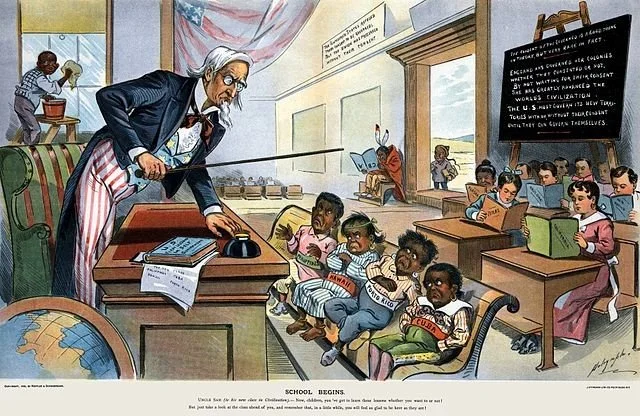
Political cartoons have played an important role in U.S. history by using humor, symbolism, and satire to comment on politics and society. Over the centuries they have frequently shaped public debates and influenced perceptions of major issues such as immigration, war, racism, colonialism, and U.S. expansion. While many cartoons challenged injustice and held leaders accountable through sharp critique, others reinforced harmful stereotypes and promoted ideas of white supremacy. Studying these images provides insight into how media can sway public opinion and shape the ways people perceive different communities, political debates, and the structures of power that govern society.